


Description
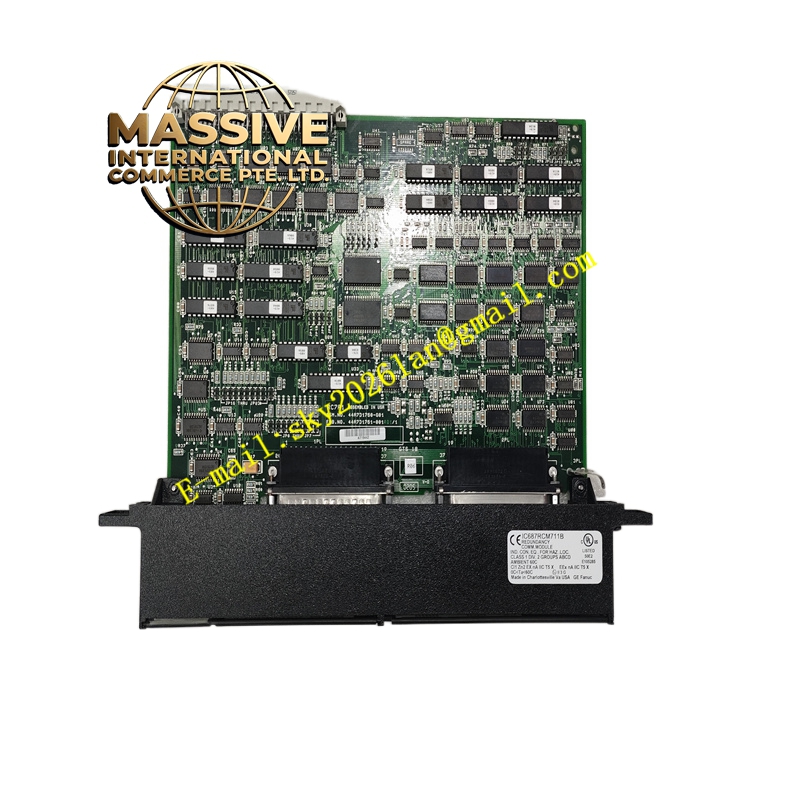
GE IC687RCM711 Technical Specifications:
- System Compatibility: Exclusively compatible with GE Fanuc 90-30 Series PLCs (e.g., IC693CPU311, IC693CPU350).
- Communication Protocol: Genius Bus (GE proprietary high-speed fieldbus).
- Maximum Slaves: Supports up to 32 Genius I/O slave modules per scanner.
- Communication Rates: Configurable at 153.6 Kbps (default) or 76.8 Kbps.
- Bus Distance: Maximum cable length of 2,300 meters when operating at 76.8 Kbps.
- Power Requirement: 5V DC, supplied directly by the PLC rack backplane.
Functional Features:
- Distributed I/O Expansion: Extends the reach of the PLC to remote machinery or field panels.
- High-Speed Data Exchange: Ensures deterministic and rapid communication with remote I/O racks.
- Redundancy Support: Configurable for dual-bus redundancy to maximize system uptime.
- Hot-Swap Capability: Supports hot-swapping of slave modules to facilitate maintenance without shutting down the network.
- Visual Diagnostics: Front-panel LEDs indicate Power (PWR), Communication (COM), and Fault (FAULT) statuses.
Application Scenarios:
- Large-scale distributed control systems where field devices are spread over vast areas.
- Water and wastewater treatment plants.
- Material handling and conveyor systems.
- Redundant control architectures in critical infrastructure.
Performance Parameters:
- Throughput: High-bandwidth data transfer optimized for real-time control.
- Latency: Minimal communication delay ensuring precise synchronization between the CPU and remote I/O.
- Reliability: Industrial-grade components designed for 0°C to 60°C operating temperatures.
Material Composition & Structural Characteristics:
- Form Factor: Standard 90-30 series single-width or double-width PLC module.
- Backplane Connector: Precision-machined edge connector for secure backplane integration.
- Front Panel: Durable plastic housing with clearly labeled LED indicators and configuration switches.
Working Principle: The IC687RCM711 continuously polls the Genius Bus, sending data packets to configured slave modules and reading their responses. It translates the PLC’s internal I/O memory map into Genius Bus protocol frames. If a slave module fails to respond or reports a fault, the scanner updates the PLC’s diagnostic registers and illuminates the appropriate status LEDs.
Installation Requirements:
- Slot Placement: Install the module in an available slot in the 90-30 PLC rack.
- Bus Wiring: Connect the Genius Bus cables to the designated terminals, observing proper polarity and termination.
- Software Configuration: Use Proficy Machine Edition (PME) or Logicmaster 90-30 to configure slave addresses, baud rates, and redundancy settings.
Usage Precautions:
- Termination: Ensure proper bus termination at both ends of the Genius Bus network to prevent signal reflections.
- Cable Routing: Keep Genius Bus cables separated from high-voltage AC power lines to maintain signal integrity.
- Compatibility: Verify that all slave modules on the bus are compatible with the configured communication speed.