


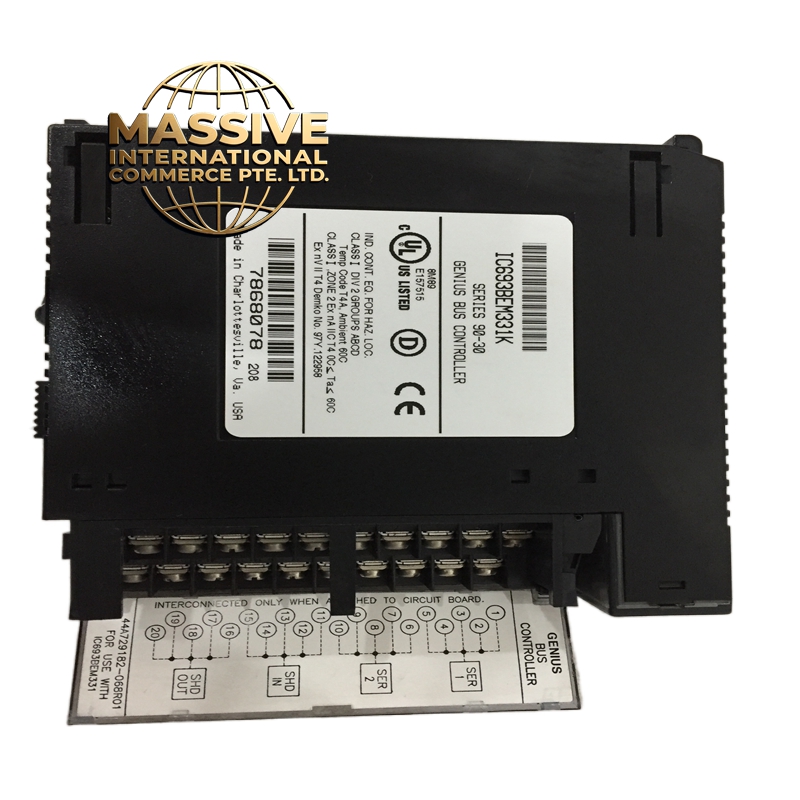
Description
GE IC693BEM331D
- Technical Specifications:
- Type: Battery backup module for 90-30 PLC
- Battery Type: 3.6V lithium battery (ER17505 or equivalent)
- Battery Life: 5 years typical (at 25°C ambient)
- Backup Duration: Maintains RAM and clock for up to 200 hours without main power (depending on CPU model and memory size)
- Charging Current: 15mA typical from backplane
- Power Consumption: Approximately 0.5W (quiescent)
- Operating Temperature: 0°C to 60°C
- Dimensions: Standard IC693 module form factor
- Functional Features:
- Automatically switches to battery power when main power fails
- Maintains all retentive memory and program data in RAM
- Preserves real-time clock and time-stamped data
- LED indicator shows battery status (charging, OK, low, failed)
- Backplane-powered for charging
- Hot-swappable battery in some configurations
- Compatible with all 90-30 CPUs (IC693CPU3xx, IC693CPU7xx series)
- Application Scenarios:
- Process control systems where power loss causes hazardous conditions
- Water and wastewater treatment plants
- Oil and gas pipeline monitoring
- Chemical process control
- Any application requiring data retention across power cycles
- Systems with time-stamped event logging
- Performance Parameters:
- Battery Voltage: 3.6V nominal
- RAM Retention Time: Up to 200 hours (varies by CPU memory size)
- Clock Accuracy: Plus or minus 1 minute per month (on internal clock)
- Switchover Time: Less than 1 millisecond (seamless transition)
- Bus Speed: Genius Bus, 10Mbps
- MTBF: Greater than 200,000 hours
- Material Composition:
- Housing: UL94 V-0 ABS plastic
- PCB: 4-layer FR-4, conformally coated
- Battery Holder: Nickel-plated steel contacts for secure battery retention
- Connectors: Gold-plated backplane edge connector
- LEDs: Red (low battery), green (OK), amber (charging)
- Structural Features:
- Standard IC693 module width
- 3 LED status indicators on front panel (charging, OK, low battery)
- Battery compartment accessible from front of module (no tools required for battery replacement)
- DIN-rail or chassis mountable
- Keying notch for correct orientation
- Working Principle:
- The module is continuously charged by the PLC backplane when main power is present. The internal circuitry monitors the battery voltage and main power status. When main power fails, a MOSFET switch instantly (within 1ms) connects the battery to the CPU’s RAM and clock circuit, preventing any data loss. The battery supplies only the low-current retention circuit (typically 10-20mA), allowing it to last for years. When main power returns, the module automatically recharges the battery and switches back to main power.
- Installation Requirements:
- Mount in IC693 or IC695 chassis adjacent to the CPU (recommended within 2 slots)
- Insert the lithium battery before powering up the PLC
- Verify battery is seated correctly — the module will not function without a battery installed
- Replace battery every 5 years or when the low-battery LED illuminates
- Do not mix battery types — use only the specified 3.6V lithium cell
- Usage Precautions:
- Replace the battery before it fully depletes — the low-battery LED gives approximately 30 days warning
- Do not use rechargeable batteries — use only the specified primary lithium cell
- Do not dispose of lithium batteries in regular trash — follow local hazardous waste regulations
- Verify battery status LED is green (OK) before relying on backup function
- In safety-critical applications, test the battery backup function periodically by simulating a power loss