


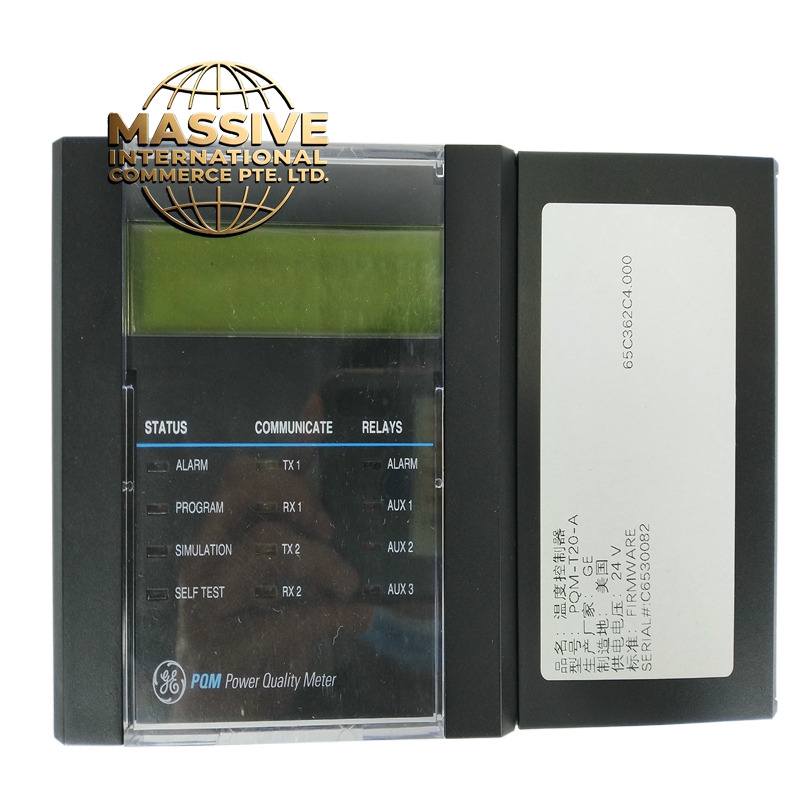
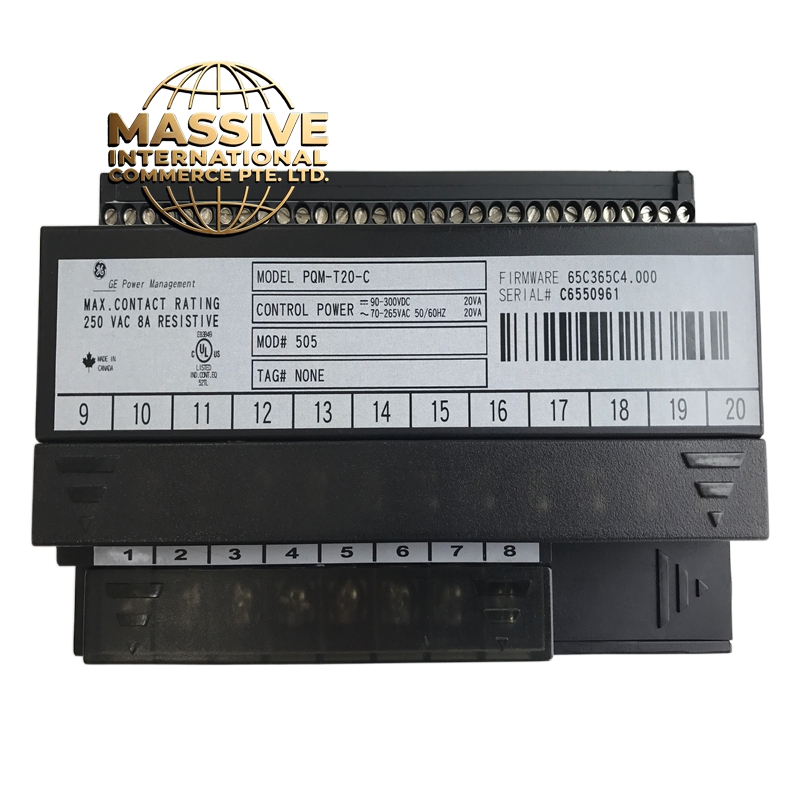
Description
GE PQM-T20-A Technical Specifications:
- System Compatibility: Designed for three-phase AC networks.
- Communication Ports: Features a front-panel RS232 port and dual rear-panel RS485 ports utilizing the ModBus RTU protocol.
- Analog Outputs: Four isolated analog outputs (0-1mA or 4-20mA) capable of transmitting any monitored variable.
- Digital Inputs: Four programmable digital (dry contact) inputs for status monitoring.
- Relay Outputs: Four programmable output relays for control and alarming.
- Power Supply: Universal power input supporting 70-265V AC or 90-300V DC.
Functional Features:
- Comprehensive Metering: Accurately measures phase currents (Ia, Ib, Ic, In), phase and line voltages, true power (W), reactive power (var), apparent power (VA), power factor, and frequency.
- Advanced Harmonic Analysis: Performs up to 63rd-order harmonic analysis, including Total Harmonic Distortion (THD) and Telephone Influence Factor (TIF) to identify non-linear load issues.
- Programmable Control Logic: Utilizes configurable setpoints and relay outputs for load shedding, capacitor bank power factor correction, and over/under voltage or current alarming.
- Data Logging and Capture: Includes a waveform capture function, an event recorder for up to 150 events, and a data logger capable of storing up to 98,000 events.
- Ethernet Compatibility: Fully compatible with MultiNet serial-to-Ethernet converters for seamless SCADA integration.
Application Scenarios:
- Monitoring and metering of distribution feeders, transformers, and generators.
- Power factor correction and capacitor bank control in industrial plants.
- Troubleshooting harmonic distortion caused by variable frequency drives and computer loads.
- Energy cost allocation and demand management in commercial facilities.
Performance Parameters:
- Measurement Accuracy: High-precision true RMS measurements for all electrical parameters.
- Processing Speed: Rapid sampling rate to capture transient voltage disturbances and current spikes.
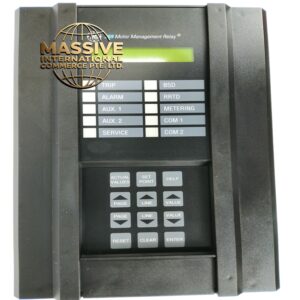
- Display: Front panel features a 40-character alphanumeric display with an integrated keypad for local configuration.
- Firmware: Flash memory allows for field-upgradable firmware to support future feature enhancements.
Material Composition & Structural Characteristics:
- Enclosure: Compact, ruggedized industrial housing designed for panel mounting.
- Circuit Board: Multi-layer printed circuit board (PCB) with high-density surface-mount technology.
- Connectors: Heavy-duty screw terminals for current transformer (CT) and potential transformer (PT) inputs, ensuring secure field wiring.
- Isolation: High dielectric isolation between input circuits, communication ports, and power supply to prevent ground loops and equipment damage.
Working Principle: The PQM-T20-A continuously samples analog voltage and current signals from external CTs and PTs. An internal microprocessor digitizes these signals and applies digital signal processing (DSP) algorithms to calculate electrical parameters and harmonic spectra. The processed data is displayed locally, transmitted via serial communication, or converted to analog signals for external PLCs. Programmable logic continuously compares real-time values against user-defined thresholds to trigger relay outputs.
Installation Requirements:
- Mounting: Install in a clean, dry environment with adequate ventilation to dissipate heat.
- Wiring: Use properly shielded twisted-pair cables for communication lines and isolated shielded cables for analog outputs.
- CT/PT Connections: Ensure correct polarity when connecting current and potential transformers to prevent erroneous readings.
- Grounding: Connect the dedicated earth ground terminal to a clean, single-point earth ground to minimize electrical noise.
Usage Precautions:
- Configuration: Use the dedicated EnerVista setup software via the RS232 port for efficient parameter configuration and data retrieval.
- Safety: Always de-energize the secondary side of CTs before modifying wiring to prevent dangerous open-circuit voltage spikes.
- Maintenance: Periodically verify measurement accuracy using calibrated test equipment and inspect terminal connections for tightness.
- Compatibility: Verify firmware compatibility when integrating with existing SCADA systems or MultiNet Ethernet gateways.