


Description
GE VMIVME-7700-110000 Technical Specifications:
- Microprocessor: High-performance x86 or PowerPC architecture (depending on specific sub-revision).
- Memory: SDRAM with ECC support for data integrity.
- Storage: Onboard CompactFlash or IDE interface for OS and application storage.
- Network: Dual Ethernet ports (10/100 Base-T) for redundant network connectivity.
- Expansion: PMC (PCI Mezzanine Card) expansion site for additional I/O or communication.
Functional Features:
- Real-Time Processing: Optimized for deterministic execution of control loops.
- System Controller: Can act as the VME system controller, managing bus arbitration and interrupts.
- Broad OS Support: Compatible with VxWorks, QNX, LynxOS, Linux, and Windows CE.
- Watchdog Timer: Hardware watchdog to automatically reset the system in case of software lockup.
Application Scenarios:
- Primary controller for gas and steam turbine control systems.
- Distributed control system (DCS) nodes.
- Real-time data acquisition and processing.
- Motion control and robotics.
Performance Parameters:
- Clock Speed: High-frequency processor for complex algorithm execution.
- Bus Bandwidth: Supports VME64x for maximum data throughput.
- I/O Latency: Low-latency interrupt handling for time-critical events.
- Thermal Design: Passive cooling design for fanless operation.
Material Composition & Structural Characteristics:
- PCB: High-layer-count PCB with controlled impedance traces for high-speed buses.
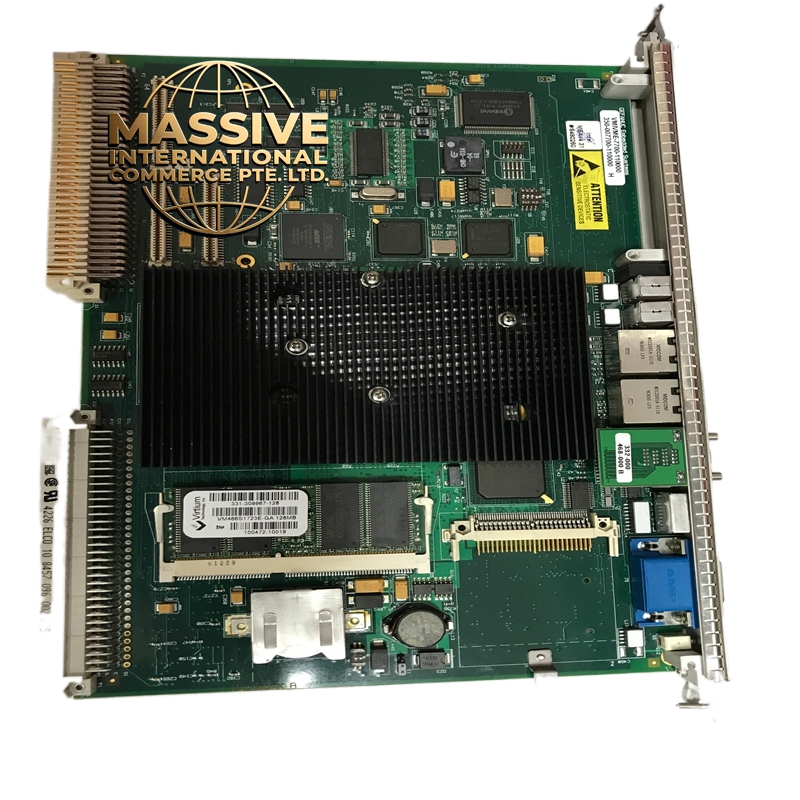
- Cooling: Large extruded aluminum heat sinks covering the CPU and chipset.
- Connectors: VME P1/P2 and front-panel RJ45, USB, and serial ports.
- Battery: Onboard lithium battery for CMOS and real-time clock retention.
Working Principle: The SBC boots an operating system from its local storage and initializes the VME bus. It continuously polls inputs, executes the control application code, and writes outputs. It manages data flow between the VME backplane, local PMC cards, and external Ethernet networks.
Installation Requirements:
- Airflow: Ensure unobstructed airflow over the heat sinks; measure airflow at the heatsink output.
- BIOS Configuration: Enter the BIOS to configure boot order, network settings, and memory timings.
- PMC Installation: Install any required PMC cards before inserting the SBC into the chassis.
- Battery Check: Verify the CMOS battery voltage before initial power-up.
Usage Precautions:
- Heat Dissipation: Never operate the board without proper chassis cooling; overheating will cause throttling or failure.
- Static Sensitivity: Handle with extreme ESD precautions due to sensitive CMOS components.
- Battery Replacement: Replace the CMOS battery immediately if the system loses time or configuration.
- Software Compatibility: Verify that the application software is compiled for the specific CPU architecture of this SBC.