


Description
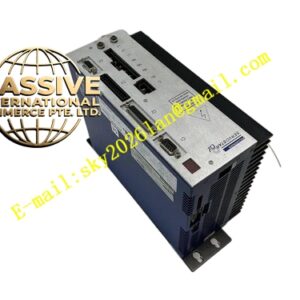
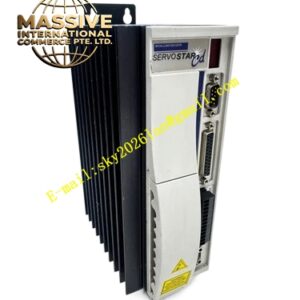
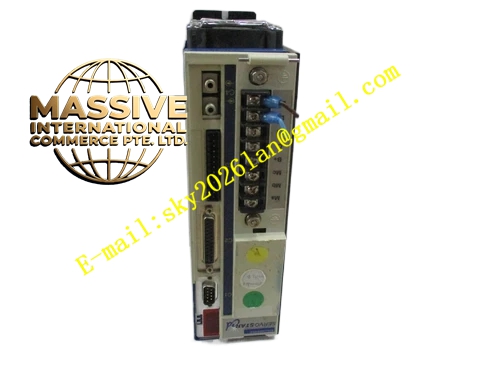
Kollmorgen MCSP16-3232
Technical Specifications
| Parameter Category | Specific Specification |
|---|---|
| Manufacturer | Kollmorgen (Danaher Motion) |
| Product Family | PC-Based Motion Controllers |
| Axis Capacity | 16 axes base, expandable |
| Motion Network | SynqNet (real-time deterministic Ethernet) |
| I/O Capacity | 32 digital I/O points (16 inputs, 16 outputs) |
| Processor | Industrial PC processor (Pentium-class or higher) |
| Operating System | Windows with real-time extension or dedicated RTOS |
| Update Rate | Up to 16 kHz servo update rate per axis |
| Programming | C/C++, Visual Basic, Kollmorgen Motion API |
| Trajectory Generation | S-curve, trapezoidal, cubic spline, PVT |
| Coordination | Linear interpolation, circular interpolation, electronic gearing, camming |
| Communication | Ethernet TCP/IP, RS-232, optional fieldbus |
| Encoder Inputs | Multi-channel incremental encoder inputs |
| Analog I/O | Optional analog input/output expansion |
| Operating Temperature | 0°C to +50°C |
| Storage Temperature | -20°C to +60°C |
| Form Factor | PCI card or standalone industrial PC |
Key Features
- Scalable Axis Count: Base configuration supports 16 axes with expansion capability, accommodating large and complex machinery
- Deterministic SynqNet: Real-time motion network guarantees servo update timing with jitter less than 1 microsecond, ensuring precise multi-axis synchronization
- High-Speed Trajectory Planning: Advanced trajectory generator computes multi-axis coordinated motion profiles with S-curve acceleration, jerk limitation, and continuous velocity blending
- Comprehensive Motion Functions: Supports linear interpolation, circular interpolation, helical interpolation, electronic gearing, electronic camming, and flying shear
- Flexible Programming Interface: Provides C/C++ and Visual Basic APIs for application development, plus ActiveX controls for HMI integration
- Real-Time Performance: Dedicated real-time kernel ensures motion control tasks execute with deterministic timing regardless of Windows background processes
- Integrated I/O: 32 digital I/O points provide machine control integration without additional PLC hardware
Application Scenarios
- Multi-axis CNC machines: Controls complex 5-axis machining centers, mill-turn centers, and grinding machines with full contouring capability
- Packaging machinery: Coordinates multiple servo axes in form-fill-seal machines, cartoners, and palletizers with electronic camming and gearing
- Printing and converting: Synchronizes print cylinders, unwind/rewind tension rollers, and die-cutting stations with register control
- Semiconductor manufacturing: Controls wafer handling robots, stepper stages, and inspection systems with nanometer-level precision
- Robotics: Coordinates articulated robot arms, delta robots, and SCARA robots with inverse kinematics support
- Metal forming: Controls multi-point press systems, roll forming lines, and tube bending machines with coordinated motion
- Textile machinery: Manages pattern weaving, yarn tensioning, and fabric handling with synchronized axis control
Performance Parameters The controller achieves servo update rates up to 16 kHz per axis with SynqNet network cycle times as low as 62.5 microseconds. Trajectory planning executes with 32-bit floating-point precision. Position command resolution is 32 bits per axis. Velocity feedforward and acceleration feedforward compensation minimize following error during contouring. The electronic gearing function supports ratios from 1:32768 to 32768:1 with phase advance/retard capability. Cam table storage supports up to 10,000 points per cam profile with linear or cubic interpolation between points.
Material Composition The controller is implemented as a PCI expansion card for industrial PCs or as a standalone embedded controller. The PCB uses 8-layer construction with separate power, ground, and signal planes. The processor is an industrial-grade x86-compatible CPU with heatsink and optional fan cooling. SynqNet network interface uses dedicated ASICs for deterministic communication. I/O interface circuits include optocoupler isolation for noise immunity. The enclosure (for standalone versions) is aluminum with ventilation slots and EMI gaskets.
Structural Characteristics The PCI card version occupies a single full-length PCI slot in an industrial PC chassis. Front panel bracket provides SynqNet network connectors (RJ-45), encoder input connectors (D-sub), and I/O connectors (D-sub or terminal blocks). Status LEDs on the bracket indicate power, network status, and fault conditions. The standalone version is housed in a compact enclosure with external connectors and mounting feet. Internal architecture includes the main processor board, SynqNet interface board, and I/O interface board connected via high-speed backplane.
Working Principle The controller runs a real-time operating system or Windows with real-time extension. The application program defines motion sequences using the motion API. The trajectory planner computes position, velocity, and acceleration commands for each axis at the servo update interval. These commands are transmitted via SynqNet to each servo drive at precise intervals. The servo drives execute the commands and return actual position and status data. The controller closes the position loop by comparing commanded vs. actual positions, generating corrective commands. The I/O scanner reads inputs and writes outputs synchronously with motion execution for machine control integration.
Installation Requirements
- Install in an industrial PC with adequate PCI slot space and cooling
- Ensure PC power supply provides sufficient +5V and +3.3V current for the controller card
- Connect SynqNet network in a ring or star topology using shielded Cat5e cables
- Install Kollmorgen Motion Suite software including real-time kernel extension
- Configure network node addresses for each servo drive using WorkBench software
- Connect encoder feedback cables to controller encoder inputs for master/slave applications
- Wire digital I/O using shielded cables with proper grounding
- Install anti-virus software that is compatible with real-time extensions
- Configure Windows for optimal real-time performance (disable power management, screen savers)
- Back up motion programs and parameter files regularly
Usage Precautions
- Do not install software that conflicts with the real-time kernel; verify compatibility with Kollmorgen support
- Maintain SynqNet cable integrity; damaged cables cause network faults and axis shutdowns
- Monitor network status LEDs; flashing or off LEDs indicate communication problems
- Keep controller PC free of dust; clean air filters monthly in industrial environments
- Perform regular backups of motion programs and cam tables to prevent data loss
- Update motion software only after verifying compatibility with existing application code
- Do not modify SynqNet node addresses while network is active
- Ground the controller PC chassis to the machine ground bus for noise immunity
- Schedule regular maintenance to check connector tightness and cable condition