


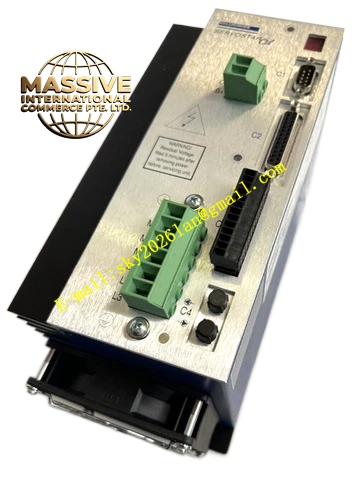
Description
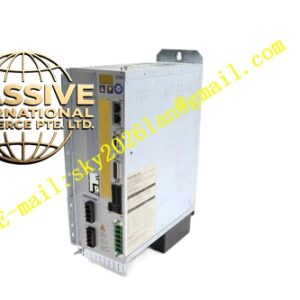
Kollmorgen S701-FN2
Technical Specifications
- Product Family: SERVOSTAR S700 Series
- Size Class: S701
- Device Designation: S701-FN2
- Product Category: Digital Servo Amplifier
- Rated Line Power (S1): 1.1 kVA
- Rated Line Voltage: 3×208 V (−10%) to 3×480 V (+10%)
- Rated DC Bus Voltage: 290–675 VDC
- Rated Output Current: 2.5 Arms at 3×208 V / 3×230 V; 2 Arms at 3×400 V; 1.5 Arms at 3×480 V
- Peak Output Current: 4.5 Arms
- Safety: Dual-channel STO (Safe Torque Off)
- Onboard Communication: CANopen and EtherCAT
- Expansion Card: F2 controlled fan option installed in Slot 2
- Certifications: UL listed (file E217428), CE, TÜV
Functional Features
- Controlled Fan (F2 Option): Fan switches on/off or runs at 50% speed based on heat sink temperature and brake power, reducing average noise emission
- Fan Switching Thresholds: Fan off below 55°C heat sink / 60°C internal / 20 W brake power; fan at 50% around 58°C / 65°C / 30 W; fan fully on above 65°C / 75°C / 45 W
- Multi-Loop Control: High-speed current, velocity, and position control loops
- Autotuning: Automatic PID parameter and feedforward adjustment
- Cogging Suppression: Minimized motor cogging for smooth operation
- Macro Programming: IEC 61131-3 structured text with 128 KB code memory
- Multi-Feedback Support: Up to three simultaneous feedback systems
- Dual-Channel STO: SIL2/PLd compliant safe torque off with dual-channel monitoring
- Dynamic Braking: Integrated braking circuit with standard internal braking resistor
- MMC Storage Card Slot: Parameter and firmware backup
Application Scenarios
- Noise-Sensitive Environments: Laboratories, cleanrooms, medical facilities, and office-adjacent production areas
- Precision Automation: Semiconductor handling, optical inspection, and micro-positioning
- Packaging Machinery: High-speed filling, labeling, and wrapping systems
- Machine Tools: Feed axes and tool changers requiring quiet operation
- General Industrial Automation: Conveyor systems, assembly equipment, and material handling
Performance Parameters
- Drive Type: Digital servo amplifier with IGBT power stage
- Control Modes: Torque, speed, and position control
- Protection Features: Overcurrent, overvoltage, undervoltage, overtemperature, phase loss, short circuit, and soft start
- Motor Overload Protection: Solid-state protection at 130% of full load current
- Short Circuit Rating: Suitable for circuits delivering not more than 42 kA rms symmetrical amperes at max 480 VAC
Material Composition
- Durable metal enclosure housing integrated power electronics (IGBT module with floating current measurement), control circuitry, EMC filter, heat dissipation components, and F2 controlled fan option card
Structural Features
- Form Factor: Compact single-channel servo amplifier
- Mounting: Panel mounting inside control cabinets
- Expansion Slots: Slot 1 (empty), Slot 2 (F2 controlled fan card installed), Slot 3 available
- Connectors: Power input/output terminals, motor connection terminals, feedback connector, STO inputs, and fieldbus interface
- Shield Connections: All shield connections made directly to the amplifier
Working Principle
The S701-FN2 receives three-phase AC power, rectifies it to a DC bus voltage, and drives the connected servo motor through its IGBT power stage. The drive uses closed-loop feedback control for precise torque, speed, and position regulation. The F2 option card monitors internal temperature, heat sink temperature, and brake resistor power dissipation to dynamically control the cooling fan speed, optimizing the balance between thermal management and acoustic noise.