


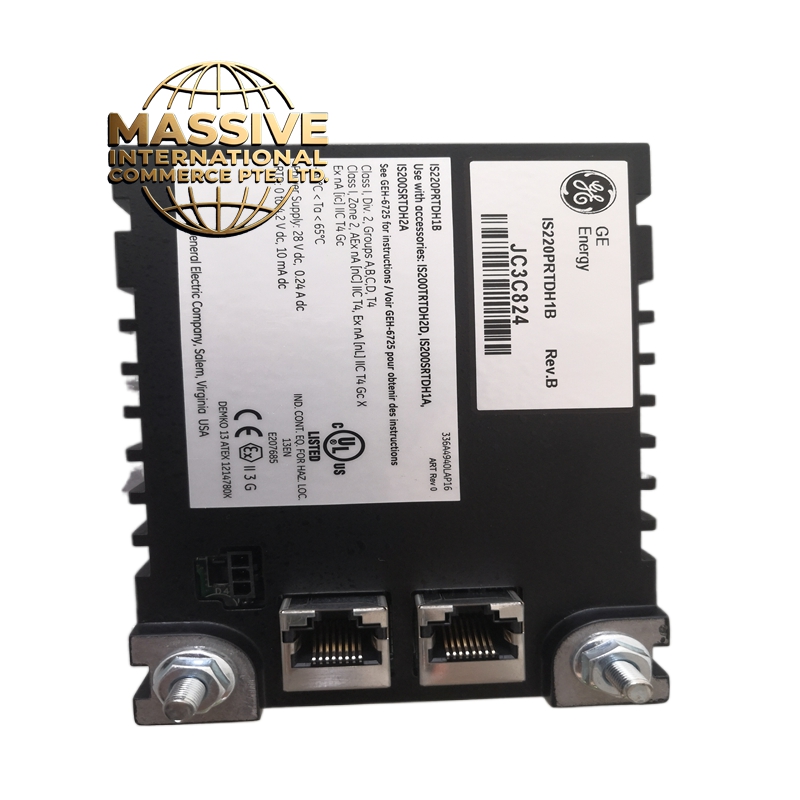
Description
GE IS220PRTDH1B Technical Specifications:
- Input Type: RTD (Resistance Temperature Detector) inputs only.
- System Compatibility: Mark VIe / Mark VIeS Speedtronic System.
- Terminal Board Compatibility: IS200TRTDH2D, IS200SRTDH1A, IS200SRTDH2A.
- Power Supply: Internal power supply with front-panel power LED.
- Certifications: CE Marked, UL Listed (E207685).
- Hazardous Area: Approved for Class I, Division 2, Group IIC when used with approved terminal boards.
Functional Features:
- High-Accuracy Measurement: Precision signal conditioning for exact temperature conversion.
- TMR Architecture: Supports Triple Modular Redundancy for safety-critical temperature monitoring.
- Status Indication: Front-panel LEDs for power, attention (ATTN), and dual Ethernet port status.
- Self-Powered: Contains its own internal power supply, simplifying cabinet wiring.
Application Scenarios:
- Gas turbine and steam turbine exhaust and bearing temperature monitoring.
- Critical process temperature measurement in oil and gas refineries.
- Safety system temperature interlocks in hazardous environments.
- Industrial boiler and heat exchanger monitoring.
Material Composition & Structural Characteristics:
- Dimensions: Approximately 34 x 18 x 10 cm.
- Weight: Approximately 4.40 lbs (without packaging).
- PCB Construction: Multi-layer board with precision analog front-end components.
- Connectors: Side-mounted Ethernet ports and backplane edge connectors.
Working Principle: The module supplies a precise excitation current to the connected sensors. It measures the resulting voltage drop, calculates the resistance, and converts it to a temperature value using standard RTD curves (e.g., Pt100). The digital temperature values are processed, scaled, and transmitted over the I/O bus to the main controller for display, control, and safety trip logic.
Installation Requirements:
- Sensor Wiring: Connect sensors using properly insulated cables as per local electrical codes.
- Terminal Board: Must be paired with the correct compatible terminal board for hazardous area compliance.
- Mounting: Securely mount the module in the designated I/O slot and engage the extraction levers.
- Configuration: Define the RTD type, wiring configuration (2-wire, 3-wire, 4-wire), and scaling in the control software.
Usage Precautions:
- Input Restriction: ONLY connect resistive RTD sensors. Connecting voltage or current sources will damage the module.
- ESD Protection: Always use ESD precautions when handling the module to protect sensitive analog circuitry.
- Cable Integrity: Periodically inspect cables for insulation degradation or moisture ingress.
- LED Diagnostics: Use the ATTN LED to identify channel faults or open RTD conditions.