


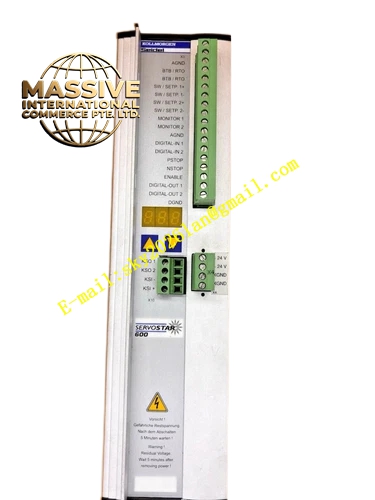
Description
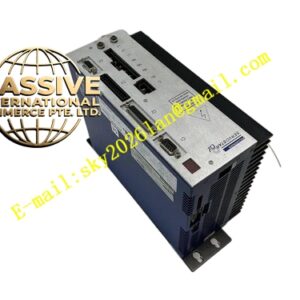
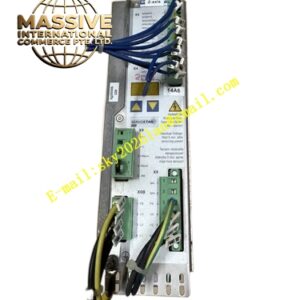
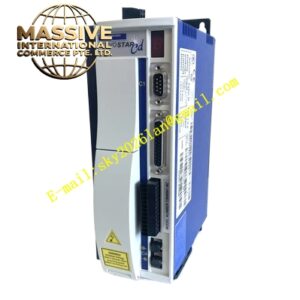
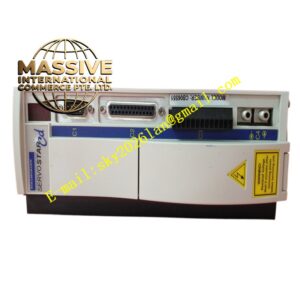
Kollmorgen S60301
Technical Specifications
- Product Family: SERVOSTAR 600 (Standard Version)
- Device Designation: SERVOSTAR 603-AS
- EU Order Code: DE-90351
- US Order Code: S60301-NA
- Safety Option: -AS (Restart Lock for Personal Safety)
- Nominal Current Range: 1.5 A to 10 A (based on S601 through S610 sizing)
- Auxiliary Supply Voltage: 24 VDC, electrically isolated, internal fusing (3.15 AT)
- Certifications: UL (cUL) listed under file number E217428, UL 840, UL 508C, CE, GOST-R
Functional Features
- Digital Servo Control: Provides precise torque, speed, and position control through cascaded digital control loops
- Restart Lock (-AS Option): Prevents unintentional restart of the drive for personnel safety, implemented with positively driven relay contacts
- Multiple Feedback Support: Compatible with resolvers, sine encoders (with BiSS, EnDat 2.1, Hiperface), incremental encoders, and Hall sensors
- Fieldbus Connectivity: Supports CANopen (DS301/DS402), with optional expansion cards for PROFIBUS, SERCOS, DeviceNet, EtherCAT, and SynqNet
- Electronic Gearing: Supports master-slave operation with up to 16 slave amplifiers
- Setup Software: Configurable via DRIVE.EXE setup software through RS232 serial interface
Application Scenarios
- Industrial Automation: Production line control, material handling, packaging machinery
- Machine Tools: CNC machine tools, cutting and forming equipment
- Medical Equipment: Medical imaging devices, surgical robots
- Semiconductor Manufacturing: Precision positioning in semiconductor production equipment
- Multi-Axis Systems: Up to six amplifiers can be connected together using special multilink cables
Performance Parameters
- Current Rating: 3 A class (SERVOSTAR 603 designation)
- Brake Circuit Upper Switch-On Level: 400–430 V (for 601–603 models)
- Brake Circuit Switch-Off Level: 380–410 V (for 601–603 models)
- Analog Output Resolution: 10 bit
- Analog Output Update Rate: 62.5 µs
- Digital Input Standard: IEC 61131-2 Type 1 (High: 11–30 V, Low: -3 to +5 V)
Material Composition
- Metal housing with integrated electronic components including IGBT power stage, digital signal processor, and brake resistor circuit
Structural Features
- Instrument Width: 70 mm (for models rated 1.5 A to 10 A)
- Mounting: 2 or 4 hexagon socket screws (M5), requiring a 4 mm Allen key
- Connectors: Mating connectors X3, X4, X0A, X0B, X7, X8 included; SubD connectors and motor connector X9 not included
- LED Display: Front panel LED display for status, error codes, and warning messages
- Additional Connector (X10): Available on -AS variants for safety relay connections
Working Principle
The S60301 receives AC input power, converts it to DC bus voltage, and drives the brushless servo motor through its IGBT power stage. Cascaded digital control loops (current, velocity, position) provide precise torque, speed, and position control. The feedback device monitors the motor’s rotor position and speed, and the drive continuously adjusts the supplied current and voltage to correct any deviations from the commanded motion. The -AS restart lock adds a hardware safety layer that prevents the drive from restarting until the safety circuit is properly reset.
Installation Requirements
- Mounting inside a closed switchgear cabinet
- Proper EMC-compliant grounding and shielding for all cables (do not use painted/non-conductive mounting plates)
- External fusing required for AC supply protection
- 24 VDC auxiliary supply from an external power source with insulating transformer
- Wait at least 5 minutes after disconnecting from main supply before touching potentially live sections
- For motor cable lengths above 25 m, a choke box must be wired into the motor lead close to the amplifier
Usage Notes
- Verify motor voltage and current ratings match the drive specifications
- Monitor thermal conditions during continuous operation
- Back up drive configuration parameters regularly
- The -AS option must be functionally tested during setup and after every alteration in wiring
- The -AS restart lock is exclusively intended to provide safety for personnel by preventing restart; the machine builder must generate a hazard analysis for the complete machine